

Do This Now, in This Order
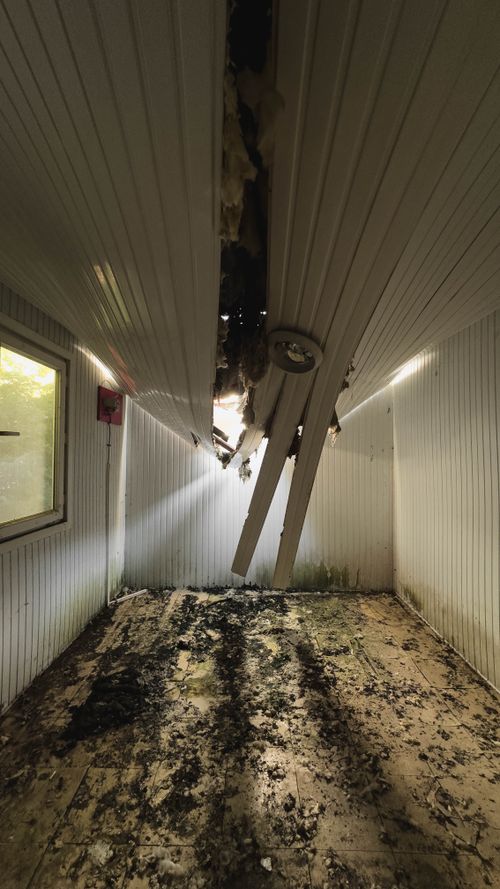
- Clear the area under the leak. Move furniture, electronics and rugs. Keep people and pets out from under any sag.
- Switch off the breaker for lights and ceiling fans in that room, from dry ground.
- Catch the water with buckets, pots or a trash can, with towels around them to catch splashes.
- Find the source and stop it:
- Near the AC closet or under the attic air handler: turn the AC off at the thermostat.
- Under a bathroom or near plumbing: shut off the main water.
- During or after rain: it is likely the roof; call a roofer for a tarp.
- In a condo: call the manager to get into the unit above.
- Take photos of the ceiling, the drip and any damage below.
- Call for drying so the attic insulation and ceiling drywall do not stay wet.
Should I Poke a Hole in My Ceiling?
Only if the ceiling is bulging with water and you can do it safely. A bulge is water pooling on top of the drywall, and it can give way all at once. To release it in a controlled way:
- Put a large bucket or trash can directly under the lowest point of the bulge.
- Make sure there is no light fixture, fan or wiring at that spot, and the breaker is off.
- Stand to the side, not underneath, and use a long screwdriver to make a small hole at the lowest point.
- Let it drain into the bucket, and enlarge the hole slightly if it drains too slowly.
If the ceiling is sagging badly, cracked or soft across a large area, stay out of the room and call. Do not poke a hole near a light fixture.
Water Dripping From a Ceiling Light Fixture
Treat this as an electrical hazard. Do not touch the switch or the fixture. Turn off that circuit at the breaker panel from dry ground, or the main breaker if you are unsure which circuit it is. Keep everyone out of the room until an electrician has checked the fixture and wiring after the water is stopped.
Ceiling Dripping in Multiple Spots
Water on top of a ceiling spreads along the drywall and insulation and drips wherever it finds a seam, a nail hole or a fixture. Several drips usually mean a larger amount of water above, often from an attic AC overflow, a burst attic line or significant roof damage. Put containers under each drip, shut off the AC or water, and call; a wide wet area above the ceiling usually means the insulation has to come out.
Don't Do This
- Don't stand under a sagging ceiling
- Don't turn on lights or fans in the wet ceiling
- Don't go into the attic during a storm or walk on ceiling drywall between joists
- Don't paint over the stain; it will come back if the drywall or insulation is still wet
What It Usually Costs
A small leak caught early may only need drying, a stain-blocking primer and paint. Wet insulation and sagging drywall add to the cost. Nationally, most water damage restoration jobs cost about $1,300 to $6,000.
Photos to Take for Insurance
- The ceiling stain, drip or sag, up close and from across the room
- The source, such as the AC closet, attic line or roof damage
- Damaged belongings below
- Water on the floor and containers catching drips
Ceiling Leaking Questions
Water is coming through my ceiling. What do I do first?
Clear the area, switch off power to fixtures in that ceiling, catch the water, then find and stop the source and call (239) 356-5803.
Should I poke a hole in my ceiling?
Only to drain a water-filled bulge, standing to the side, with a bucket below and no light fixture or wiring nearby. If the ceiling is badly sagging or soft, stay out and call.
Water is dripping from my ceiling light. Is it dangerous?
Yes. Do not touch the switch. Turn off that circuit or the main breaker from dry ground and keep everyone out until an electrician checks it.
Ceiling Still Wet?
Call (239) 356-5803. We answer 24/7 to dry ceilings, attics and the rooms below across Cape Coral, plus North Fort Myers and Fort Myers. Once the drip is under control, read how we handle water-damaged ceilings and attic insulation.